The Confidence Guy

Wired into Truly Confident Living

Category: ‘Building self-esteem’

Oct 15

I’m about to get a little fluffy.  Forgive me, it’s only temporary.  I’ll be swearing like a drunk docker before you know it.

I was doing my mindfulness meditation (that I’m still not doing nearly as much of as I want or need to be) from the pioneering and wonderful Jon Kabtat-Zinn, and  my ears tuned in on a particular passage of dialog that I wanted to share with you.

Audio clip: Adobe Flash Player (version 9 or above) is required to play this audio clip. Download the latest version here. You also need to have JavaScript enabled in your browser.

Just this moment
Just this breath
Just this drinking in of the air
This flowing of the air
Through the body
This giving and receiving of the air
This unfolding of life
Moment, by moment, by moment
In awareness

This struck me as important, for one simple reason.

My life, and your life, is unfolding right now.

Breath, by breath, by breath.  Moment, by moment, by moment.

Each breath comes and brings a new moment in your life, a place you’ve never been before.  And as it fades, so does that moment in your life.

Always something new.  Always a new start.

This happens by the very nature of life, moving forwards without any pondering, any striving or any struggling.

I have no doubt that my next breath will come; that the next moment will come.  I have no doubt that my life will unfold without me forcing it or telling it to unfold.

It doesn’t get any simpler than that, and I trust it implicitly.

True self-confidence is trusting your ability to meet that unfolding of life in awareness.

Sep 24

Do you trust in God more than you trust in yourself?I don’t really understand religious people.

I mean, I can understand the need to belong to something bigger than yourself, and I think that’s an honourable and fundamental human need, but I don’t get why that ‘thing’ needs to be a set of beliefs that some guy came up with yonks ago that you’re supposed to just accept as truth.

Your brain is hardwired to make sense of the world around you; without that facility you’d simply go nuts.

But while this need to derive meaning and belief from the data around us is central to being human, the content of those beliefs – whether you believe in goblins, a political leader or a higher power – is entirely up to us.

This remark outrages the sensibilities of those who have deep religious convictions and attachments and they regard it as insulting,” says Prof AC Grayling from the University of London.  ”But the truth is that everyone takes this attitude about all but one (or a very few) of the gods that have ever been claimed to exist.”

“No reasonably orthodox Christian believes in Aphrodite or the rest of the Olympian deities, or in Ganesh the Elephant God or the rest of the Hindu pantheon, or in the Japanese emperor, and so endlessly on.”

This makes complete sense to me, but what doesn’t make so much sense is taking someone else’s belief system and adopting it as your own.  It’s like doing a Sean Connery impression and expecting to be allowed into MI6.

Another professor, Professor Bruce Hood, is the author of a fascinating book called “Supersense” and a very clever man.  He agrees with me,

I would say that our brains are programmed to try and understand what causes things to happen in the world and coming up with a supreme being seems to be the most sensible and easy solution…. and it is one of the reasons religions have been so successful” he says.

We’re all looking for answers.  We’re all searching for a path that feels right to us, a path we’re eager to follow because it just might give us those answers.  The easy way is to follow a path that’s already carved out and marked, and in that way I think religion is often the easy way out – a way of dodging self-actualisation in order to find an already carved out self-concept and world-view.

I’ve come across individuals who place their faith in a God above their faith in themselves, and I gotta say, I have a problem with that.

The impact of believing in a God more than you believe in yourself is vast.  That belief in a higher power may give you strength at times, it may give you comfort and it may give you hope.  But how much more amazing would it be if you came to see that those qualities come from your own self, rather than looking to be granted those qualities by a supernatural being?

Believing in God more than yourself means that you externally seek to be granted the values and qualities that you are capable of manifesting internally.

It means you get to miss out on the threads of gold that YOU have.  It means you don’t fully feel the true scope and scale of what your head and heart are capable.

To my mind, what’s altogether more powerful, more life affirming, more graceful and more freeing, is knowing and exploring your own belief system based on the things that matter to you, personally.

What’s more self-actualising is the evolution of your own beliefs and your own values, rather than having that work done for you and grappling with them to try to make them fit.

I know I’m likely to get into trouble with this post because it’s an emotive and deeply personal subject.  Yes, I fully accept that religion does make you ask questions and it does make you think, but at the end of the day it ends up in faith – the catch-all argument to end all arguments.

It’s that unquestioning belief that I take issue with, because, for me at least, the magic of life is in exploring the world and your own heart and mind in a spirit of openness, curiosity and grace.

Sep 02

Do you need to be more selfish?The Errey family have a peculiar knack of putting everybody in the world ahead of themselves. Right now I’m giving my all at my current freelance gig, a high-pressure, non-stop environment where I’m putting doing great work ahead of my own needs, including my health.

I should be prioritising meditation and getting well ahead of working hard for my team, but I’m not.

I don’t know where we get it from, but as far back as I can remember we’ve all stepped back and done things for other people, whether it’s each other, partners, colleagues, bosses, friends or whoever else happened to need something.

Now, I think that’s awesome – it’s important to be there for people you care about and selflessness is a rare trait indeed.

But I wonder what the cost of that has been, for all of us.

My family would happily swim the Atlantic on a bread board if it meant being there to help a friend or family member in need, but at what point do you say have to say “No more, get lost“?

I know this sounds like I’m saying “Screw everyone else, just look out for yourself“, and to some extent that would be true.

The simple truth is, you’ve got to have the confidence to put yourself first.

You have to be the most important person in your world.

At its most benevolent, this is about the times when you don’t speak up or don’t make your voice heard.  At these times you’ll end up sitting on your hands so that you don’t run the risk of upsetting anyone or looking silly.

Going up the scale is falling into people-pleaser syndrome, then higher still is becoming a “bottomless pit” – doing things for everyone else without regard to yourself.

Perhaps at the top end of the scale is staying in an abusive relationship because you don’t want to hurt your partner, don’t want to rock the boat or don’t believe you have a choice in the matter.

All of these things stem from a lack of confidence to exert yourself in your own life, letting other people take the lead because you want other people to feel good about you and because you’re trying to feel good about yourself.

Nobody else can do it for you – you have to make yourself important in your own life.

The cost of these patterns of behaviour are high indeed, and being very male about it I’m going to apply a formula to solve these complex equations.

If you can’t afford, on a personal level, to put into a relationship what you’re putting in, you need to get out.

What does that mean? It means that if you personally don’t have available what you’re about to give, you have to make a different choice.

You can’t damage yourself to make someone else feel better.

That’s too high a price, and even though it might take more guts, courage and confidence than you think you have, there’s always another, better way.

You might not be comfortable with the word ’selfish’.  Fair enough, feel free to use ’self-centered’ instead.  Or perhaps self-confident. The point is that it’s about self.

You.

A few days later…

That’s the article as I originally wrote it.  And while I agree with every word I said, there was something about it that’s been troubling me.

It’s this.

I honestly believe that generosity of spirit is the human race’s finest quality.  I have to remind myself of that frequently, as it’s all too easy to become jaded or cynical.

I honestly believe that giving of yourself has a nobility and grace that goes beyond a reasoned argument for pulling back and protecting yourself.

Yes, there are times when you need to make a choice to put yourself first, but there are also times when your instinct to do that can be better replaced with that spirit of generosity and giving.

It’s saying “What can I do for you?” rather than “What can I do for me?

I think that’s how you can rise above your own limitations and realise that you’re more powerful than you let yourself be.

What do you think?

Aug 20

Sabotaging yourself is than a sack of weasels – why the heck would you go and do a bunch of stuff to make sure you don’t get what you want? Crazy indeed, but it’s something we’ve all done.

Keep doing it and how can you expect to have any confidence in your ability to get results in your life? With sabotaging behaviour, there’s a sad inevitability that you’ll end up with low self-esteem and no self-confidence.

To demonstrate the problem, here’s a recent email exchange I had with Barbara from Madison (thanks for agreeing to feature your email B). We went on to have a fantastic 30 minute session, where we were able to laser right into what was happening and get some rapid insights. I loved talking with her and it was so cool how her eyes were opened to a different way of doing things. Here’s how it started.

I’ve always wanted to work from home as a writer, a novelist. Since that does not pay bills, writing direct mail copy and catalog copy is an option for me. I used to be a vp/creative director at a direct marketing agency so I have experience in copywriting and customer service and marketing. And I can’t take the first step.

I’m 50 so I feel old and out of touch. I don’t have experience with online copy so that’s a negative. And everytime I come close to reaching a goal I sabotage myself. Even with weight. Whenever I’m within 10 pounds of my ideal weight i eat junk and gain. Funny thing is, everyone thinks i’m such a positive person. Help!”

Barbara, Madison, CT, USA

First of all Barbara, there’s no way that 50 is old these days.  Not a chance.  You’ve still got another a few careers left to go if you want them!

It’s pretty clear how important writing is to you, but I get the sense you’re second guessing how good you are or how good you might be, and then slipping into looking at all the reasons why it won’t work.  If you’ve always had a pull towards writing there’s a good chance you have a talent there, and as you’ve had experience as a CD there’s a weight of evidence to support that.

Instead of looking at the reasons ‘why not’, how about looking for the reasons ‘why’?  Copywriting is a core skill that only needs a little tuning appropriate for the channel – as long as you can write on a subject with thought to tone, message and audience, you’re all set.

You’re pretty good at beating yourself up, aren’t you?  What’s the reason for being so hard on yourself, and what do you think your nearest and dearest would say if you told them the things you tell yourself?

There’s a habit here, and habit’s are hard to break.  The trick is to notice when you’re slipping into that automatic well-known behaviour (self-sabotage, self-criticism, eating junk, etc) and stopping yourself.  Noticing it with brutal honesty is important. Without that you won’t have a chance to do something else.  When you notice it, take a step back.  Remind yourself of what’s important to you and look at the evidence for why you’re darned good and get ready to make a different choice.

Right before I saw your email I had a home-made cupcake with two inches of vanilla frosting and half a bag of potato chips with dip. I have spent the last two weeks trying to lose weight and lost eight pounds. I am within ten pounds of my ideal weight and look what I did. It’s funny, actually it’s not funny at all. So I read your email and the tears started flowing. You are good!

Hearing what you had to say, that I am so hard on myself and asking why, kind of startled me and made me realize that this has been a life-long thing with me. And as I said, I try to be positive and am great at comforting other people. So why can’t I comfort myself? I would love to have a 30-minute session with you.

I got the sense that there was a lot of emotion sitting just under the surface of your email, and it looks like that’s the case.  Losing 8 pounds in 2 weeks is a great achievement, so 3 things re the weight loss thing –

  1. How can you take credit for losing 8 pounds in 2 weeks?  That’s a good thing, right?
  2. Who set this ‘ideal weight’ of yours?  Where did it come from and is it realistic?  What happens when you get there?
  3. The cupcake thing – what was in it for you?  People repeat a pattern of behaviour because they get something out of it.  Apart from the fact that they’re tasty, what are getting from it?

So, the lifelong beating yourself up thing.  Where do you think you learned that?

If the ‘comforting, nurtuting, caring’ you were to sit down and talk with the ‘beating yourself up’ you, what would she have to say?

Mar 02

Not too long ago I watched ‘Lady in the Water‘, a movie that got universally panned, but which holds a strange fascination and beauty for me.

M. Night Shyamalan’s films have been a bit up and down, but I like what he does  (he’s the guy who did ‘The Sixth Sense’ if you don’t know him).  What I like about his movies is his peculiar knack for looking into humanity and weaving magic into what he sees.

A talented guy.

Anyway, ‘Lady in the Water’ is a magical film that ’s described as ‘a bedtime story’ (just watch the clip and try not to be drawn into the magic of it) and there’s one stand-out line from the film that leapt out of the screen and left me pretty much speechless.  I wish I could have found it online somewhere to show you, but you’ll just have to rent it instead.  In this scene, the mesmerising Bryce Dallas Howard softly asks Paul Giamatti, “May I say one thing?”

“The moment a person finds their voice…is the moment their life takes on grace.”

Just sublime.

I’m not a religious man so the word ‘grace’ holds no religious connotations for me.  I’m grateful for that, because it offers me a definition of the word that’s threaded with gold.

Grace is simplicity, effortlessness and congruity.

Think about it.  What are you speaking with before you find your voice?  What are you saying?  And who are you being before you find grace?

Everything before you ‘find your voice‘ means that you’ll be struggling with things in and around your life, for the simple reason that you’re missing something fundamental.

Your life might be full of clutter and noise.  You might feel like you’re searching for something.  You might drift through much of your career, with no real plan or agenda.  You might feel, in those quiet moments, that something’s missing.

You’ll be dying a slow, safe death.

And all because you haven’t found your voice; that voice that gives you elegance, ease and a sense of wholeness.  That voice that gives you the confidence to do things your way, follow what matters and relax into yourself.

Find your voice, find grace, find confidence.

One thing flows into the next.

Dec 18

Christmas gifts under a Christmas tree‘Tis the season to be jolly, and if we’re to believe what the world-famous, big, jolly round man in the suit says (that’s Santa, not Norm Peterson) it’s a time for giving.

As Bill Murray’s character Frank Cross said in ‘Scrooged’ (one of my favourite Christmas movies — I couldn’t even count the number of times I’ve seen it) when he was receiving the award for humanitarian of the year – “Sometimes I’d find myself hurting, from giving too much. And I’d say, stop it.”. The irony being that all he gave was a company branded face cloth to his employees. The gift that keeps on giving.

So I got to thinking what this giving lark is all about.

At it’s simplest you give something in response to a request for help. Someone asks for something and you give it. Someone asks for a fish and you give ‘em a fish. Someone else asks for a song and you give ‘em a song.

It’s not just restricted to fishes and songs (or songs about fishes) — the most stunning example of this was when I read about a guy who asked for help after he wrote off his car in a horrible car accident. He asked for help taking care of his bills and people responded.

People gave.

The guys at Men with Pens then raised the prickly issue of whether you’d have enough courage to ask for help in the same situation, and in my confidence work I’ve learned that the resounding answer is No. People have a hard time asking for help for all kinds of reasons – they fear ridicule, they fear looking weak, they fear that it takes away from what they’ve achieved and they fear people saying No in response.

People fear being rejected and being alone, but have learned so much independence that they play a solo instead of joining the orchestra.

James is right in his article, it doesn’t have to be that way (and he came up with a brilliant idea to help change things). Sure, people have a heap of issues around asking for help but people have an equally sized heap of issues around giving – and that’s where I want to go with this post.

There’s obviously a big emphasis on giving at Christmas, but like puppies, I don’t think this particular human trait should be just for Christmas. As Brett Legree says over at 6 Weeks, “Give, and give again – even if they don’t ask for help.

Giving is one of humanities most amazing qualities

Giving is one of humanities most amazing abilities.

And we all have it.

It has the potential to change the world if only we’d figure out how to do it consistently and gracefully.

But people have a hard time giving in the right ways and I think there are 3 reasons for that –

1. They’re too wrapped up in their own stuff to notice when or where they can give.
2. They feel self-conscious about giving – they feel silly or awkward because they don’t know how to give or a part of them feels like it’s not appropriate.
3. They fear that what they give will be rejected.

Notice how similar those reasons are to the reasons people don’t ask for help? Just thought I’d point that out. :-O

It takes guts to give.

You have to trust yourself that you’re giving in the right spirit – not to get back but simply because you’re able to give.

You have to trust that even if what you give is rejected, it doesn’t stop you from giving again.

You have to trust that giving doesn’t take away from what you have and who you are, but adds to it.

You have to trust that giving is valuable, even when it appears thankless.

And that trust takes self-confidence.

Like all these things, there’s a balance to be struck. Don’t become a bottomless pit of giving, where your self-worth becomes tied in to how much you give to others. I’ve worked with some habitual bottomless pits in my time, and it’s a tough habit to break.

Don’t give to get validation back – that’s entirely the wrong spirit.

The right spirit is to give without expectation of reciprocity and to give the right things. Don’t give someone a private jet in the hope that they’ll give you a 70ft yacht in return (although if you have a spare jet or yacht lying around I won’t say no). Instead, give unconditionally of the following things –

1. Your time.
Time is precious, and giving someone your time is hugely valuable. Take a couple of hours to help a friend out with something they’re working on. Take time to call a family member or put time aside to have a cup of coffee with someone who could use a friendly ear.

2. Your attention.
Giving someone your attention can make all the difference in the world. I’m afraid to say that sometimes when I’m with a friend I’ll find myself drifting off and thinking about other stuff, tuning out of where I am and what’s being said. Giving your attention let’s people know they’ve been heard, and it’s gold dust.

3. Your resources.
Giving someone your resources is about giving what’s appropriate. This doesn’t have to be about things – money, objects, gifts, etc – but can be about giving the resources you have in abundance – your strengths, talents and values. If you’re great at something offer to help someone out where they might be struggling. If you know a way for someone to get a great result, offer to help out.  Give what you’re naturally good at (just don’t be smug about it).

Giving of yourself without expectation or attachment is what raises you from a mammal to someone who’s embracing what it is to be human and participating fully in the world.

So tell me, what can you give, today?

Nov 27

How thanksgiving can add to your self-esteemIf you happen to be in the USA today then Happy Thanksgiving to ya. Hope you have a great day with people who matter to you.

Save me a slice of pie.

If you’re not in the USA read on anyway, because there’s some important stuff here.

I’m running the risk of sounding as vapid as a Miss World contestant when talking about gratitude – it sounds like it fits right in with talking about world peace and how the children are the future.

I’m not a fan of the fluffy bunny school of self-help (I’ve pissed off a few coaches in my time), so while I may stray once or twice into the fluffy zone in this article my intention is to talk about what ‘giving thanks’ and ‘being grateful’ means in practical terms – terms that you can take away as use productively for the benefit of your confidence and self esteem.

How being thankful is relevant to YOU

First up, a couple of definitions for you –

thank.
1. to express gratitude, appreciation, or acknowledgment to.
2. a grateful feeling or acknowledgment of a benefit, favor, or the like, expressed by words or otherwise.
3. have oneself to thank; have the responsibility.

gratitude.
1. the quality or feeling of being grateful or thankful.

So with those definitions in mind, being thankful and grateful is about 3 things.

1. Acknowledging the good stuff.
If you’re going about your days without seeing the good stuff or noticing what makes you feel good, then you’re missing out on some of life’s most simple pleasures.

2. Taking responsibility.
A huge part of experiencing thankfulness is being responsible for your own experiences. It’s very easy to go about your life, bouncing from one thing to the next while disregarding and disowning the successes you have.

You think to yourself, “I didn’t do anything“, “That was just a fluke, I got lucky” and “I can’t believe that happened, I don’t deserve it“, or even worse, you don’t think at all about your successes and the good stuff you have around you.

To really nail this ‘thanks’ business, you need to honestly and simply own your successes and all the good things you have in yourself and your life. This isn’t about being smug, it’s about being honest.

3. It’s not what you do.
Gratitude and thanks are about how you are, not what you do.

It’s about experiencing the feeling of being thankful or grateful, and allowing that feeling to happen without stamping on it, forcing it or over-thinking it.

But hang on just a cotton-pickin minute there. Why be thankful at all? What’s the point?

A simple way to answer that question is to look at the alternative. What would it be like if nobody was thankful or grateful? What would it be like if nobody batted an eyelid when something good happened? How would it be if you never paid attention to what feels good in your life?

Yuck.

The point of being thankful is to make your life a richer place to spend time in.

Gratitude isn’t just a ‘nice to have’, it makes a fundamental difference to how you experience life.

That’s why there’s a big link between being grateful and how you feel about yourself, because you can only do those 3 things if you have a healthy level of self-esteem and feel confident enough to express what matters to you. That’s why it has to start with participating fully in your life.

Get that nailed and it can grow and grow. The richness of experience it gives adds to your self-confidence and self-esteem. The shift of perception it offers you allows to notice and leverage more of the good stuff around you every day. The value it adds to you allows you to be a better version of yourself, and that ripples out and touches everyone else in your life.

At the end of the day, the best way of giving thanks is to add to the richness of experience of someone else.

Here’s something to try. No cheating.

1. When you wake up tomorrow morning write down 7 things that you’re grateful for. Be as specific as you can. Don’t just scribble down ‘My family’, write down ‘How my husband smiled at me this morning’.

2. Before you go to bed tomorrow night, write down another 7 things that you’re grateful for. Be specific and don’t duplicate any you wrote down in the morning.

3. Now comes the tough bit – repeat this routine every day for a total of 21 days. 7 things in the morning, 7 things in the evening.

4. Don’t repeat any. If you duplicate one, start from day 1 again.

It sounds tricky, but it’s a bloody good exercise. You’ll be richer for it, trust me.

Nov 05

How do you compare yourself to others?As someone who spends too much time on Facebook, I occasionally get emails from the ‘Compare People’ application, which tells me how I rank on a wide range of factors based on how my friends have compared me to their other friends.

These emails tell me in no uncertain terms where I’ve lost rankings and where I’m up in rankings. If I chose to, I could take it personally when I see that I’ve dropped 2 places in the ‘Most Entertaining’ category, that I’ve lost 1 ‘Smartest’ place or that I’ve slipped to the 6th ‘Most Dateable’.

I can be pretty damn entertaining when I want to be, I think I’m one of the smartest people I know and I like to think I’m a darn good catch for the single women in London.

But I don’t take it personally because I recognise 3 things:

1. The context of the rankings is one of throw away fun.
2. The rankings don’t reflect the way things actually are, being a subjective and unscientific comparison.
3. The rankings don’t reflect how I see and value myself.

Are you comparing yourself with people at work?

But it’s not just Facebook where I’m compared with others. In the workplace it’s common to compare yourself with your peers and the people below you and above you in the company. “He gets paid twice as much as me and does half the work” and “What she produces is always poor, so why do the managers love her so much?” are just a couple of things I’ve heard from colleagues, friends and clients.

Why do you feel the need to compare yourself with others at work?
Comparing yourself with a colleague is an easy way for you to judge how well you’re doing based on the differences between you, and is something we all do naturally. You might compare yourself on how popular you are, how efficient you are, how much time you spend in the office, how much you’re paid, how good you are at networking or any one of a hundred other factors.

What is common with all of these is that what you’re looking for is a measurement, a way of gauging how well you’re doing or a way of validating how well you’re doing (or not).

I remember one time back in the 90’s when I was working with a hugely capable and wildly popular guy on a high profile project. I asked myself questions about why he was more outgoing and popular than me and how he was able to establish a higher profile and garner more respect than me.

What I didn’t see until the project was done and I’d moved on to something else, is that I was also popular and had an equally high profile (if not higher), being able to influence key players and have people at the top listen to and act on my opinions. And I kicked myself when I found out that a couple of the women on the client team had the hots for me, but because I was under the mistaken belief that I wasn’t as popular as the other guy, I had no idea.

The problem comes when you look at the fact that these comparisons are coloured with your own perceptions and meanings, and are therefore entirely subjective. Mary might get paid more than you but that’s because she’s in another department or has more responsibility than you’re aware of. John might be able to bend the ear of key managers, but that’s because he has the confidence to speak up and has demonstrated that his opinions have value.

Don’t let your comparisons affect your beliefs and behaviour.

Are you comparing yourself with the right people?
If you insist on comparing yourself with a colleague – and it’s a hard habit to break – you need to be careful that you’re comparing yourself with the right people.

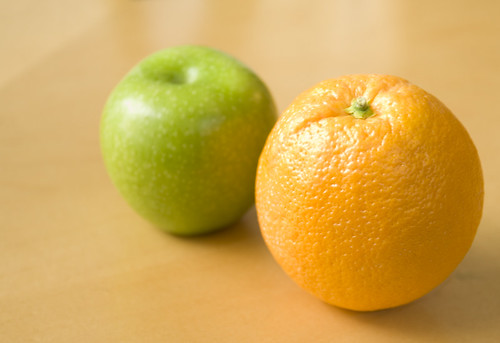
Are you comparing apples with swans?You have to compare apples with apples for the comparison to make sense, right? If you compare apples with swans then the comparison is flawed from the start – you might reach some kind of comparison but it’ll be nonsensical. An apple won’t peck you to death but a swan a day won’t keep the doctor away. And that’s just one silly example.

Comparing yourself with the CEO when you’re working in the post room is only going to make you feel crappy, but comparing yourself with a peer in a similar job in a similar industry makes a comparison relevant.

Penelope Trunk recently wrote that you should compare yourself to losers. While that’s a strategy that will work and will make you feel better about how you’re doing, it’s based on the fact that you’re looking for someone who isn’t performing at your level so that you can feel good. Keep doing that and it’s likely you’ll turn into a judgemental, back-stabbing loser yourself.

So I’d suggest that breaking the habit of comparing yourself with your co-workers is the most promising and confident way to go. It means that you need to be confident enough in what you’re doing and how you’re doing it so that you don’t need to look behind or in front to see where other people are in comparison. That doesn’t mean that you can’t look to others for input, a new perspective or to find out about what they’ve learned.

Compare yourself to what you know about your own previous performance. Compare yourself with how well you know you can perform and the quality of the work you turn out.

When comparison are made, take it all with a pinch of salt
Workplace comparisons are subjective, even if the comparison comes from appraisals. Don’t take it too seriously and if someone else (like your boss) is comparing your performance then take it with a pinch of salt – whether the comparison is favourable to you or not. It’ll be based on their perspective and their context.

Are you comparing yourself with your partner or friend

Another place where people compare themselves a little too often for my liking, is in personal relationships. Here are just a handful of situations I’ve coached clients through–

- A woman compared herself sexually, based on stories told to her about her boyfriends previous girlfriends. Consequently she began to doubt that she was delivering the goods (so to speak), pandered to her boyfriends sexual whims and rarely reached orgasm because of the pressure she was putting on herself.

- A woman compared herself to the success her boyfriend had achieved in his organisation. Consequently she felt like she was being left behind and that she couldn’t match up to his expectations.

- A man compared himself to his wife’s outgoing personality, and created a belief that he was introverted and introspective. Consequently, he started taking fewer chances because he believed they ‘weren’t for him’.

- A successful entrepreneur compared herself to her boyfriend who was unemployed. Consequently she felt like her success was ‘rubbing it in’, began to filter what she talked about around him and despite loving him she started resenting him and feeling guilty about resenting him.

- A woman compared herself to her oldest friend. Consequently, she felt overweight (she wasn’t), unpopular with men (she never gave herself a fair chance) and unsuccessful (she was great at her job in actual fact, but didn’t give it her all because she felt she couldn’t succeed).

Are you comparing yourself to your partner?What’s the reason you’re comparing yourself to him or her?
In a relationship or friendship, comparing yourself is a way of establishing the ‘pecking order’ and trying to establish your own security. You look at how you differ from the other person so that you’re aware of your social role and so you can spot any gaps you need to cross, holes you need to fill in or areas you need to work on.

It’s a remnant from our old tribal days, when there was a distinct social and familial hierarchy that determined your role in the unit. It’s a way of figuring out where you fit, where you belong.

What’s it doing to you?
The impact on the individuals in the examples I mention above is clear. And that’s just a small sample of the people I’ve worked with who’ve experienced similar things. Just yesterday I replied to an email sent by 16 year old girl who was comparing herself to her best friend and feeling 2nd best as a result.

Comparing yourself unfavourably to someone else will hit your confidence hard. It’ll strip your self esteem and shrink your beliefs about who you are and what you can do.

Stop it.

You’re different people so there will be differences. Comparing yourself to a friend or partner will only highlight those differences, and if you’re not watching what’s happening you can start shifting your beliefs based on those differences.

By all means be aware of the differences between you (difference management is an incredibly useful strategy in a long term relationship, both friendships as well as romantic relationships) , but the action isn’t to eliminate those differences it’s to honestly acknowledge them and even celebrate them.

Don’t let your differences take away from who you are. Your differences are what makes you you, and they’re your best assets.

The bottom line is that comparisons are just dandy as long as you understand that they’re subjective and understand how they’re affecting how you go about things. When you automatically make comparisons and choose a behaviour based on that comparison, you’re running the risk of making choices that take away from your confidence. You’ll run the risk of damaging how you see yourself.

And that’s the kind of damage that’s hard to reverse. It’s the kind of damage you don’t want to cause to yourself. Really, you don’t.

Oct 28

It's easy to smile, but how do you remain positive?“Question for you Steve, how do you maintain the positivity, you obviously do as it comes across in your writing. This is a problem I have, I can think positive for short periods of time but then go back into a negative state soon after. How do you do it?” – Steve in Derbyshire

How do I maintain the positivity? The honest answer is that sometimes I don’t.

While I probably am more naturally inclined towards positivity, especially since I started coaching people, there are days when I feel low and there are days when I feel sad. I roll with the punches, have my down days and am as much of a work in progress as the next guy.

Pretending that I’m ‘up’ all the time or thinking that I’m not allowed to be down is not going to get me anywhere. And it would be really annoying for everyone else. All it will do is create a gap between how I think I ought to be experiencing my life and how I’m actually experiencing it.

Positive thinking isn’t all it’s cracked up to be, so don’t get hung up on not being positive all the time.

There’s a story about a woman looking out of her kitchen window at her overgrown, weed-filled garden, saying to herself “There are no weeds, there are no weeds“. While that’s certainly a positive thought it doesn’t reflect the reality of the situation or put her in a position to change it. All she’s done is create a gap between what she wants to experience and what’s really happening, a gap that doesn’t allow her to move forwards.

It takes courage to ride a wave when that wave is full of fear, emotion and a reality you’d rather avoid.

Riding the wave, even if it’s taking you somewhere unknown, means that you have to resist the natural urge to hide under the duvet or run away and focus on the fundamentals of being you.

The key is to acknowledge what’s happening and your experience of it – if you feel crappy then feel crappy, if you feel good then feel good – and then be willing to make a choice. That willingness to experience the bad and the good is a huge piece of what confidence is, and it’s something I’ve learned from working with clients over the last few years.

That said, there’s an irony here that intrigues me.

The acknowledgment and willingness to experience what’s happening allows you to make choices that you otherwise wouldn’t be in a position to make. If you develop a radical self-honesty it makes it easier to make decisions about what matters to you and what you do with what’s happening.

The woman with the garden full of weeds can say, “Look at all those weeds. Is this something I want to do something about?“, and if she wants to she can get out there with her trowel and change things.

Simply by being willing to experience the bad as well as the good you allow yourself to move forward with greater freedom in your experience, and a natural positivity emerges. With a foundation of self-honesty and self-confidence in place, positivity just comes more naturally.

So I guess my answer to the question “How do I maintain the positivity?” is that I maintain my positivity by letting myself off the hook for not being positive all the time.

Sep 28

I found peace on top of a rock in New YorkI got back from my trip to New York a couple of days ago, and I had a whale of a time out there. But there was one moment of my trip that was different from all the others, one moment that gave me a fresh experience and a new insight.

To be honest with you, I’m a bit sorry to be back home as a lot of people here seem to be a lot ruder and less respectful. It troubles me. Plus, in New York I know I’m just a short hop away from a darn good meal and a well made martini.

So while I’ll be looking for more ways to spend more time in the USA, that’s not what I want to tell you about right now.

Last Sunday afternoon I headed into Central Park. I’d been out the night before and was pretty fried, so I wanted an afternoon of lying in the grass and schlepping around by myself. A little quality Steve time, if you will.

The weather was beautiful – temperature in the 80’s, clear blue sky, just stunning. As you might imagine, the park was busy with friends and families strolling, picnicking, lolling and playing, and after a spot of people watching I managed to find a more secluded spot on the south side of the lake.

Right on the shore of the lake I clambered up a rock and sat on top, and once I was comfy (and surprisingly the rock was very comfy indeed) I just sat there. The odd row boat came by, but other than that I simply sat, and looked, and let my mind and body rest.

Instead of thinking about what I needed to do, where I needed to go and who I needed to talk with, I just sat and cleared my head.

When all the buzzing things in your head slow and stop, all you’re left with is the real you; the quiet you that’s right at your core.

I don’t think I’ve felt as peaceful for years.

When you stop moving completely all you’re left with are all the good bits, bad bits and work in progress-y bits that make you you. If there’s something there that you don’t know about, that’s incongruent or doesn’t fit with who you know yourself to be, then there’ll be discomfort.

My coaching method takes people to this sense of okayness and makes you confident down to your core, and even I sometimes need reminding of what that truly feels like. It’s so easy to loose that in the middle of everything in our lives and it was SO GOOD to remind myself of it.

Leslie, a friend of mine who I met up with in NYC, sent me a thank-you card about 13 years ago that I still remember today. In it she’d written –

“To those of us in constant motion, here’s to finding that spot.”

That’s what I found on top of that rock in Central Park; it’s part of what taking a holiday is all about and it’s something I intend to keep a hold of.